SciFi Vision | All Reviews | Television Reviews | The Bad Guy – The Walking Dead: Dead City 1X01, Old Acquaintances Review
The Bad Guy – The Walking Dead: Dead City 1X01, Old Acquaintances Review
 “[The Dead City] universe is going to tell the story of what happens when you lose someone [to murder]. Not just for the person who lost him, but the person who did it.”
--Eli Jorné, interview with SFX, June 2023
Just before the title sequence for The Walking Dead: Dead City plays for the first time, Maggie Rhee (Lauren Cohan) pulverizes the head of a walker using a telescope. She brings the makeshift weapon down repeatedly as she screams in rage, blood and brain matter splattering her face. The visual reference is obvious to anyone who has watched The Walking Dead’s flagship show. But just in case it isn’t, “Old Acquaintances” later provides a flashback to Negan (Jeffrey Dean Morgan) crushing Glenn Rhee (Steven Yuen)’s head with a barbed-wire-wrapped baseball bat, while Glenn’s pregnant wife Maggie watches.
From the outset, Dead City suggests that its main protagonists, Maggie and Negan, are two sides of the same coin. The show’s premiere is not shy about this intention, and neither is its creator, Eli Jorné. The widow and her husband’s killer are inextricably linked, the opening scene reminds us, separated only by a flip, a flick of the fingers, a choice. Not a choice made by the characters, but one made by the viewers.
 In his research for Dead City, Jorné read stories of reconciliation, most notably one about a woman who corresponded with her teenage son’s killer while he was incarcerated. “For her that relationship with her son’s murderer became the only path out,” Jorne observes in an interview with SFX Magazine. Somewhat less figuratively, Maggie’s relationship with Negan is her “only path out” in the six-episode series, which is rumored to have a second season in the works. Her son, Hershel (Logan Kim), has been kidnapped by a man nicknamed “The Croat” (Željko Ivanek), and imprisoned in Manhattan. Negan is the key to getting the boy back. “Old Acquaintances” sees the two reunite outside a motel, where the former Savior has been staying with his charge - a young girl called Ginny (Mahina Napoleon), mute since the death of her father.
 On the surface, this is a solid premiere. The colorful title sequence, playing to a cheesy Eighties synth intro, promises gristly walkers, the New York skyline, and a CGI deer slightly better than the one (in)famously used in The Walking Dead’s seventh season. The scene is set, the players named, the wider forces at work identified: whatever operation The Croat is running, and New Babylon, the capital city of something called the New Babylon Federation. Negan is wanted by their marshals, one of whom, Perlie Armstrong (Gaius Charles), is hunting him.
Beneath the surface, however, something unsettling is afoot, much like there appears to be in the bubbling sewers of Manhattan. Negan’s narrative arc in the flagship series was focused on his redemption for the last couple of seasons, via his tragic backstory, his relationships with Judith Grimes (Cailey Fleming) and the outcast Lydia (Cassady McClincy), and his marriage to Annie (Medina Senghore), who was pregnant with his child when the series ended. The Negan of Dead City, which is set two years after the end of The Walking Dead, is quieter, more thoughtful, and he exudes an air of avuncular wisdom at times in his conversations with Maggie. His wife and child are nowhere in evidence in “Old Acquaintances”, but the tender mutual affection between him and Ginny garners the viewers’ sympathy. He is fatherly, and attentive. By contrast, Maggie is seething with violence and rage from the moment we see her - much like Negan was when he first appeared in The Walking Dead.
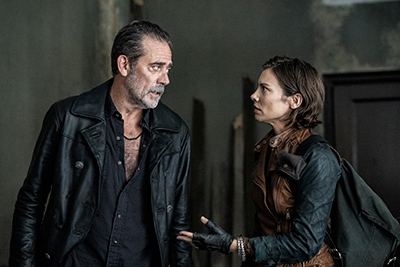 Explaining his attraction to Maggie and Negan as characters in his interview with SFX, Jorné talks about “people who are kind of broken and flawed…deep down, good people but just struggling to make their way through the world with whatever they’ve been handed.” Both the widow, and the man who mocked her, laughing, as he smashed in her husband’s head, are “good people,” Jorne proposes, struggling in a world that seems to turn on them again and again. If we consider one to be a villain and one to be hero, then we are making a choice, flipping the coin. “Old Acquaintances” asks us, instead, to spin it, Negan’s and Maggie’s faces blurring into one, their crimes and their motivations becoming almost indistinguishable from one another. As they travel to Manhattan, Negan articulates this by challenging Maggie’s belief that he is “the bad guy” after all these years. “I’m not. No one is,” he snaps at her. “Or maybe everyone is. How many husbands and fathers have you killed?”
 Negan is a changed man, the writers might argue. He tells Maggie early in the first episode that he believes he has paid for what he did. He has a family, he has a foster child, he makes a living killing walkers for the motel. The marshals, on the other hand - the law-enforcers - turn out to have some questionable methods. “Who is the real bad guy?” the show wants us to ask. The answer, the script is anxious to demonstrate, is not Negan. So, is it no one? Or everyone?
The audience for Dead City might be willing to accept this narrative sleight of hand - this is entertainment television, and to a degree, it entertains. Tension crackles between Morgan and Cohan from the moment they share the screen, and Cohan does a good job of embodying vengeful loathing mingled with maternal distress. There are plenty of bells and whistles: walkers falling from the sky, cockroach swarms, a scene involving a rat which delighted me with its grotesquerie. The most significant disappointment for the casual viewer might be the glaring lack of tie-in with the rest of The Walking Dead universe. But, as a reviewer, I was left thinking that Dead City’s moral framework was premised on a troubling fallacy: that at the end of the day, all evil actions are equivalent, and that once enough time has passed, once an apology is made, the experience of the gleeful, violent murderer deserves a space, a consideration, equal to those of the people who have suffered loss at his hands. Whether enough viewers will buy this to make Dead City a success - whether they will allow the coin to be spun, and kept spinning - remains to be seen.

Latest Articles
Interviews
 Dark Matter Season 2: Blake Crouch on Expanding Beyond the Book, Diverging from the Main Story & More
 Monday, 28 September 2026
 Outlander: Blood of My Blood Season 2: Harriet Slater, Jamie Roy, Jeremy Irvine & Hermione Corfield on Love, War, & Separation
 Saturday, 26 September 2026
 Outlander: Blood of My Blood S2: Matthew B. Roberts & Maril Davis on Trauma, History & Storytelling
 Wednesday, 23 September 2026
 Dark Matter Season 2: Dayo Okeniyi on Leighton's Hubris & Oluko's Faith in the Box
 Tuesday, 22 September 2026
 Tommy & Tuppence: Josh Dylan and Antonia Thomas on Modernizing Agatha Christie
 Tuesday, 15 September 2026
 Jimmi Simpson Breaks Down Dillard’s Walker Family and His Shocking Turn on The Walking Dead: Dead City
 Sunday, 13 September 2026
 Aimee Garcia on Renata’s Hope, Trauma, and Walker Transformation in The Walking Dead: Dead City
 Sunday, 13 September 2026
 The Walking Dead: Dead City's Showrunner on Moving Maggie & Negan Forward, Episode 6 & Where a Potential Season 4 Could be Headed
 Thursday, 10 September 2026
 Dark Matter Season 2: Jennifer Connelly and Joel Edgerton on the Emotional New Season
 Saturday, 05 September 2026
 Dreams in Nightmares: Charlie Barnett, Sasha Compère & Mars Storm Rucker Talk Personal Truths & More
 Friday, 04 September 2026
Reviews


